 Bondprotocol
 auctions let you buy immediate payouts or claims redeemable after vesting
Bondprotocol auctions let you buy payout tokens by paying a market's quote token through its teller. Select a market, confirm its assets and vesting terms, authorize the required token transfer, and submit a purchase with a minimum acceptable payout. An instant market delivers payout tokens immediately; a vested market delivers bond tokens you can redeem after maturity.
Updated on
The purchase commits you to the selected asset pair and payout timing. A displayed discount describes the exchange terms; it doesn't fix the payout token's future value. You can inspect a market and stop before authorizing payment or submitting a purchase.
The market must remain open with sufficient capacity when your purchase executes, even if its quoted payout meets your minimum.
Match the market to your payment and claim date
Start with the selected market's token contracts, network, and vesting terms, then check whether it currently accepts purchases.
Quote token and payout token
The quote token funds your purchase, and the payout token is the asset your payment buys. Confirm their contract addresses on the market's network, since a matching symbol doesn't establish token identity. Treasury asset acquisition follows this exchange direction: the issuer selects the quote asset it wants to acquire and the payout asset it offers.
Vesting and purchase readiness
Read the payout timing before allocating funds. For vested purchases, fixed-term markets calculate maturity from purchase time, while fixed-expiry markets use a shared maturity date. The market's closing time governs new purchases and serves a different purpose from your claim's maturity. Remaining capacity and the maximum payout per purchase can also restrict the amount the market accepts. Capacity can use quote-token or payout-token units, so compare amounts in the unit the market uses. A direct on-chain purchase also requires the network's gas asset.
Keep the purchase unsigned if the asset pair or claim date doesn't suit your intended exchange. Inspecting those terms doesn't create a bond position.
How do I buy a bond through the teller?
Confirm the quote-token allowance and minimum payout, then submit the purchase through the teller assigned to the selected market, using its market identifier and your chosen purchase terms.
Authorize the payment
Your address needs enough quote tokens for the gross payment and sufficient allowance for the teller to transfer them. Check the spender before granting that allowance. If the teller already has enough allowance, you don't need another approval. Authorization lets the teller transfer tokens, but approval alone doesn't execute a bond purchase. Confirm the recipient and minimum payout before submitting. The minimum states the smallest payout-token quantity you'll accept, including when delivery takes the form of a vested claim. The payment amount uses quote-token units, while the minimum uses payout-token units; retain each token's decimal precision.
Check the completed purchase
Successful execution produces a
Bonded
event containing the market identifier, referrer, deposited amount, and payout amount. Check transaction success and the recipient's resulting token balance together. The teller either transfers payout tokens or issues the applicable bond claim. A pending transaction hasn't established delivery, and a vested claim's balance doesn't mean its underlying payout is already redeemable.
Keep the payout floor when the quote moves
The submitted minimum stays a purchase condition even when the market price changes before execution. The auctioneer rejects a purchase when its calculated payout falls below the submitted minimum. A quote estimates the payout under the market's current conditions; it doesn't reserve that price or override other purchase limits.
In this hypothetical fixed-term Sequential Dutch Auction purchase, the initial quote is 189 payout tokens for the selected quote-token payment. The buyer submits a minimum of 185 payout tokens, and all other purchase requirements are satisfied.
Execution calculates a payout of 183 tokens, below the expected minimum of 185. The shortfall is 2 payout tokens:
185 - 183 = 2
. The auctioneer reverts the purchase, so the recipient receives no new bond claim. The reverted transaction retains no quote-token purchase payment, although execution can still consume network gas.
Refresh the same market's quote before submitting another purchase. Keep the minimum unchanged while reviewing the new estimate; lowering it would authorize a smaller payout. If the new terms remain unacceptable, leave the purchase unsigned. The failed attempt hasn't created a position you need to redeem or unwind.
Purchase fees reduce the quote amount used for pricing
The teller deducts protocol and referrer purchase fees from the quote-token payment before the auctioneer calculates the payout. Those deductions accrue in quote tokens. The applicable rates depend on the teller and the referrer supplied with the purchase. Read the combined fee for that same referrer when evaluating the quote. Direct transaction gas adds a separate network cost; it isn't part of the payout-token quantity your minimum protects.
Auction pricing and limit orders change the entry decision
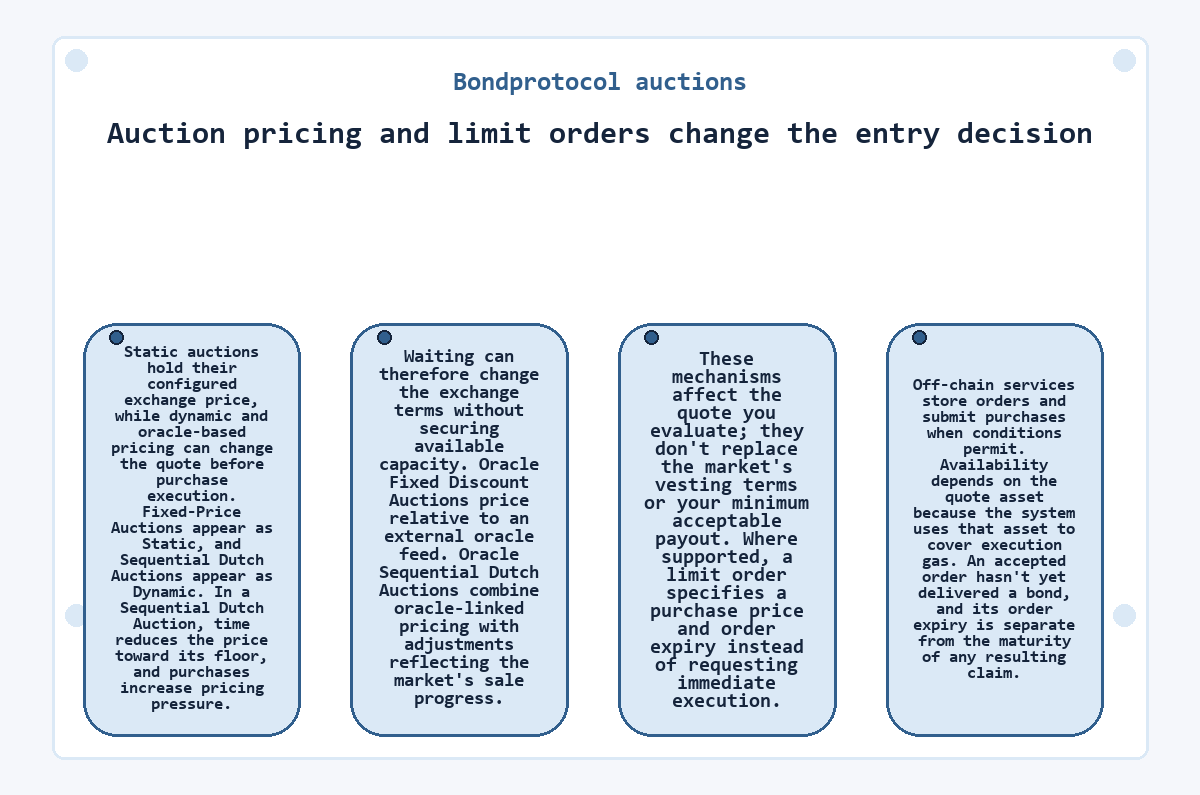
Static auctions hold their configured exchange price, while dynamic and oracle-based pricing can change the quote before purchase execution. Fixed-Price Auctions appear as Static, and Sequential Dutch Auctions appear as Dynamic. In a Sequential Dutch Auction, time reduces the price toward its floor, and purchases increase pricing pressure. Waiting can therefore change the exchange terms without securing available capacity. Oracle Fixed Discount Auctions price relative to an external oracle feed. Oracle Sequential Dutch Auctions combine oracle-linked pricing with adjustments reflecting the market's sale progress. These mechanisms affect the quote you evaluate; they don't replace the market's vesting terms or your minimum acceptable payout.
Where supported, a limit order specifies a purchase price and order expiry instead of requesting immediate execution. Off-chain services store orders and submit purchases when conditions permit. Availability depends on the quote asset because the system uses that asset to cover execution gas. An accepted order hasn't yet delivered a bond, and its order expiry is separate from the maturity of any resulting claim.
Maturity controls when the claim releases payout tokens
A vested bond becomes redeemable at its recorded maturity timestamp, so its token balance alone doesn't establish immediate access to the underlying asset. Fixed-term positions use ERC-1155 tokens. Their teller rounds purchase time plus the configured vesting duration down to a UTC day boundary. Fixed-expiry positions use ERC-20 tokens and share the market's designated maturity timestamp.
Both bond tellers reject redemption before the claim's recorded maturity timestamp. Vesting uses a cliff: no underlying payout becomes available incrementally before that boundary. A call oToken has its own exercise window and strike price; those option terms don't set a bond's redemption date. After maturity, redemption burns bond tokens and transfers the underlying payout token. Each redeemed bond-token unit releases one corresponding payout-token unit, a 1:1 redemption.
Questions and answers about Bondprotocol auctions
-
Can I buy a bond for a different recipient address?
- The teller's purchase function accepts a recipient address separate from the address paying quote tokens. The payer supplies the payment, while the recipient receives the immediate payout or vested bond claim. This directs delivery within the purchase; it doesn't change the market's assets, fee calculation, or vesting terms. Check that recipient before submitting.
-
Does a zero referrer address remove the protocol purchase fee?
- A direct teller purchase can use the zero address to avoid a referrer fee, while the configured protocol fee still applies. The teller combines both components when calculating the deduction from the quote-token payment. A quote prepared for another referrer can therefore use a different fee total. Using a zero referrer doesn't remove network gas costs.
-
Why can a fee-on-transfer quote token cause a bond purchase to revert?
- The base teller rejects a quote-token transfer when it receives less than the purchase's specified payment amount. A token that deducts a transfer fee can trigger that check, even with sufficient balance and allowance. The transfer check requires the full quoted input to arrive; changing the minimum payout doesn't correct the missing quote-token amount.
-
When can I place a limit order for a scheduled bond market?
- A supported limit order can be placed after the market is scheduled and before it opens, provided the quote asset qualifies for the limit-order service. Execution must still satisfy the order's price and expiry conditions together with the bond market's purchase rules, including the requirement that the market is active.
-
Will the teller accept a partial redemption after my bond matures?
- Both fixed-term and fixed-expiry tellers accept a specified redemption amount, allowing a holder to redeem part of a matured bond balance. The teller burns that amount and transfers the matching underlying payout tokens. The remaining bond-token balance represents the unredeemed portion. Partial redemption doesn't accelerate maturity or convert the remaining claim into another asset.
-
Are fixed-expiry bond tokens transferable before their maturity date?
- Fixed-expiry ERC-20 bond tokens support transfers before maturity, and the claim keeps its original maturity timestamp. The holder at redemption must possess the relevant bond-token balance. Token transferability alone doesn't establish an available trading venue, a willing buyer, or a sale price for a particular claim.